research
2025
-
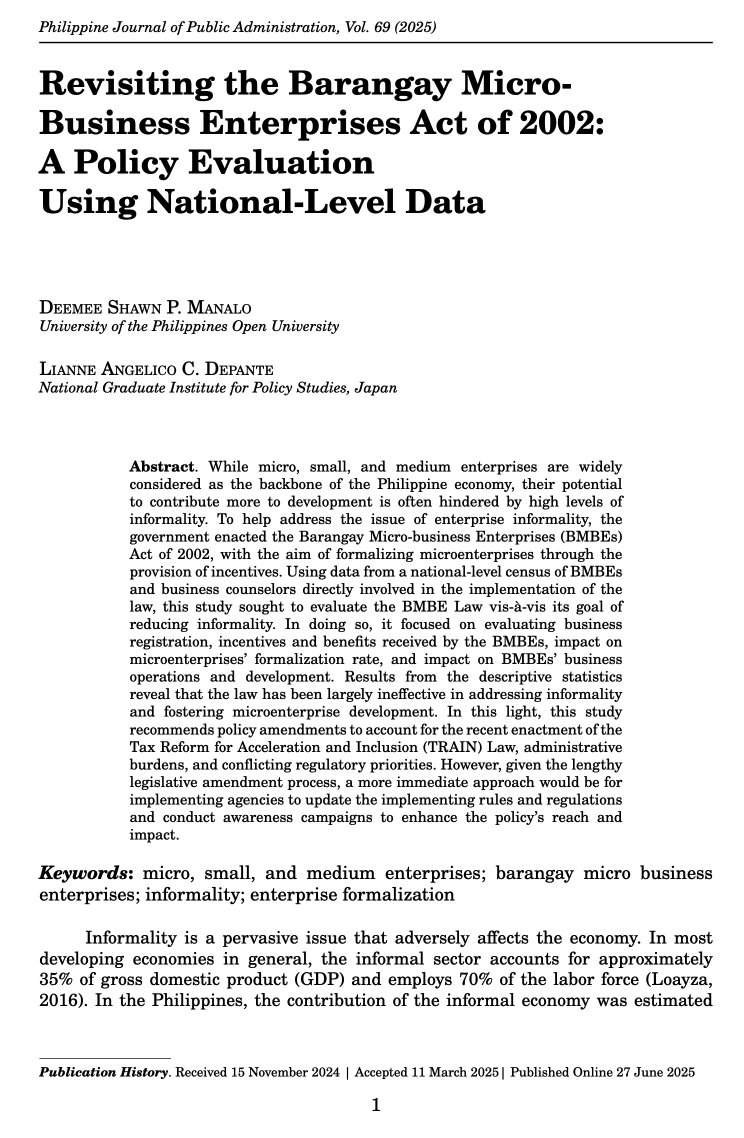 Revisiting the Barangay Micro Business Enterprises (BMBEs) Act of 2002: A Policy Evaluation Using National-Level DataDeemee Shawn P. Manalo, and Lianne Angelico C. Depante2025
While micro, small, and medium enterprises are widely considered as the backbone of the Philippine economy, their potential to contribute more to development is often hindered by high levels of informality. To help address the issue of enterprise informality, the government enacted the Barangay Micro-business Enterprises (BMBEs) Act of 2002, with the aim of formalizing microenterprises through the provision of incentives. Using data from a national-level census of BMBEs and business counselors directly involved in the implementation of the law, this study sought to evaluate the BMBE Law vis-à-vis its goal of reducing informality. In doing so, it focused on evaluating business registration, incentives and benefits received by the BMBEs, impact on microenterprises’ formalization rate, and impact on BMBEs’ business operations and development. Results from the descriptive statistics reveal that the law has been largely ineffective in addressing informality and fostering microenterprise development. In this light, this study recommends policy amendments to account for the recent enactment of the Tax Reform for Acceleration and Inclusion (TRAIN) Law, administrative burdens, and conflicting regulatory priorities. However, given the lengthy legislative amendment process, a more immediate approach would be for implementing agencies to update the implementing rules and regulations and conduct awareness campaigns to enhance the policy’s reach and impact
@article{RN7800, author = {Manalo, Deemee Shawn P. and Depante, Lianne Angelico C.}, title = {Revisiting the Barangay Micro Business Enterprises (BMBEs) Act of 2002: A Policy Evaluation Using National-Level Data}, journal = {Philippine Journal of Public Administration}, doi = {10.5281/zenodo.15744614}, year = {2025}, type = {Journal Article} } -
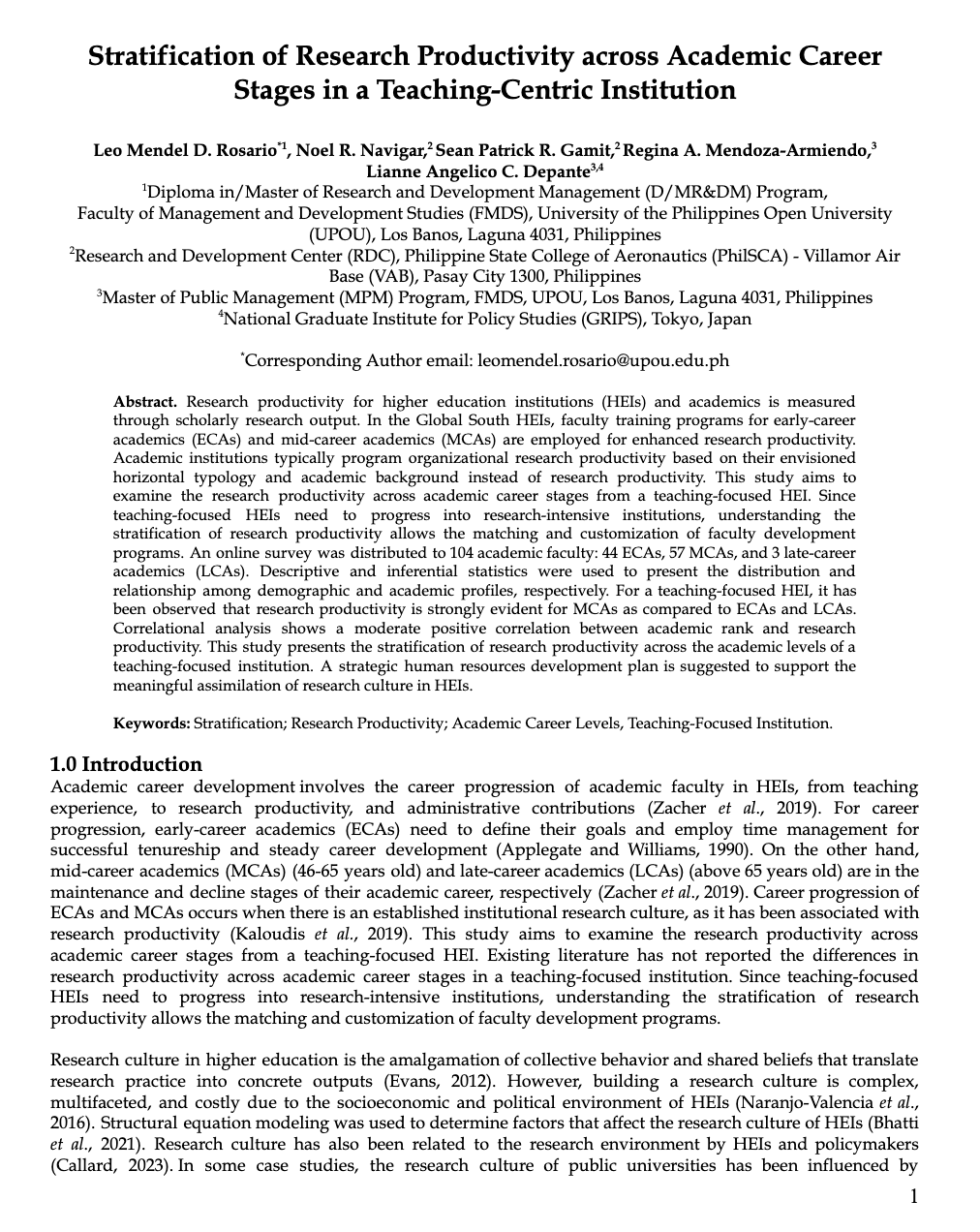 Stratification of Research Productivity across Academic Career Stages in a Teaching-Centric InstitutionLeo Mendel Rosario2025
Research productivity for higher education institutions (HEIs) and academics is measured through scholarly research output. In the Global South HEIs, faculty training programs for early-career academics (ECAs) and mid-career academics (MCAs) are employed for enhanced research productivity. Academic institutions typically program organizational research productivity based on their envisioned horizontal typology and academic background instead of research productivity. This study aims to examine the research productivity across academic career stages from a teaching-focused HEI. Since teaching-focused HEIs need to progress into research-intensive institutions, understanding the stratification of research productivity allows the matching and customization of faculty development programs. An online survey was distributed to 104 academic faculty: 44 ECAs, 57 MCAs, and 3 late-career academics (LCAs). Descriptive and inferential statistics were used to present the distribution and relationship among demographic and academic profiles, respectively. For a teaching-focused HEI, it has been observed that research productivity is strongly evident for MCAs as compared to ECAs and LCAs. Correlational analysis shows a moderate positive correlation between academic rank and research productivity. This study presents the stratification of research productivity across the academic levels of a teaching-focused institution. A strategic human resources development plan is suggested to support the meaningful assimilation of research culture in HEIs.
@article{RN7799,
  author = {Rosario, Leo Mendel},
  author_display = {Leo Mendel Rosario et al.},
  title = {Stratification of Research Productivity across Academic Career Stages in a Teaching-Centric Institution},
  journal = {International Journal of Education and Practice},
  doi = {10.18488/61.v13i3.4204},
  year = {2025},
  type = {Journal Article}
}